
How to setup Force Registration
Sign-In Page Setup

Mary Smith
Last Update منذ ٥ أشهر
A great way to capture information more immediately is to create a Kaydoh page with a force registration form. This can also be viewed as a Sign-In page. It's a page that prevents full access to Kaydoh until information is collected from the visitor. This is a great when needing to create an Open House Sign In page.
Pairing this with a Kaydoh QR code will make this a highly effective way to generate leads.
- Computer
- A Kaydoh page (existing or new)
- Read (step by step)
Edit your website or create a website. Navigate to the "Configure" tab. Sometimes, this tab can be hidden under the "More Options". Proceed to toggle on the "Force Registration (e-Form)"
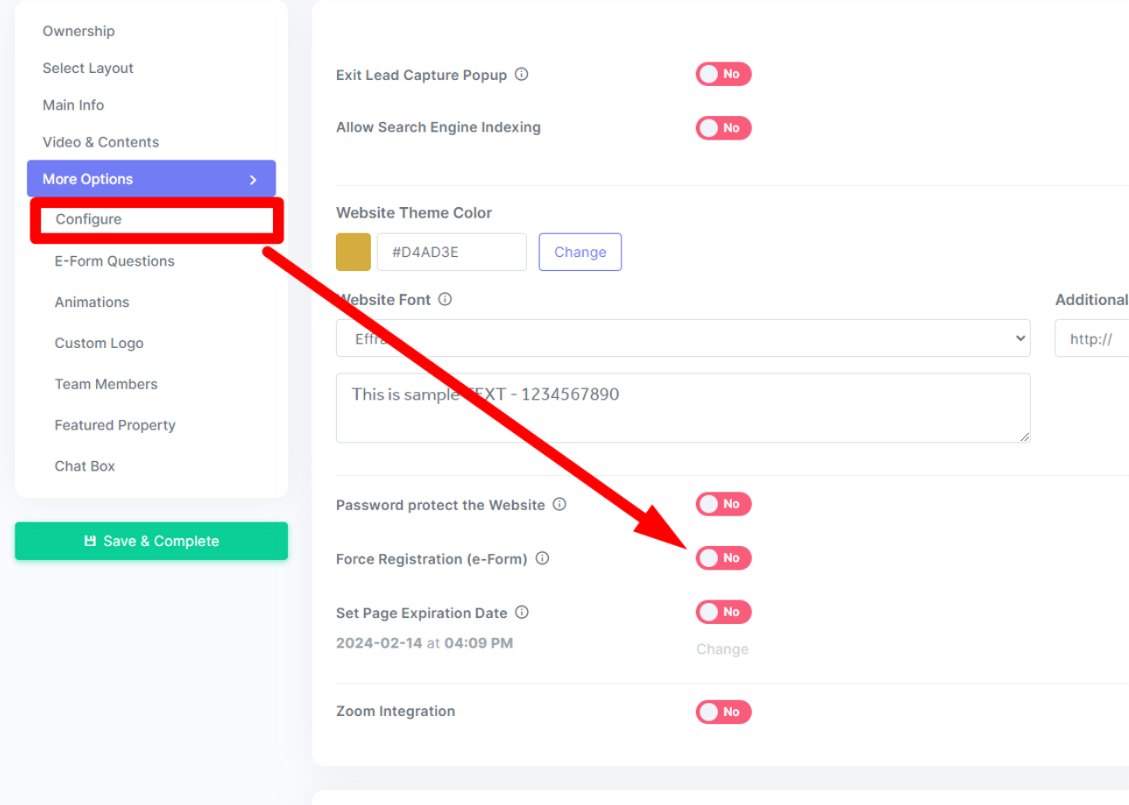
Toggle on to make the e-form display when website is loaded.

Advanced: Control Force Registration via URL Parameter
You can also control force registration by adding a parameter directly to your page URL — without changing any settings in the editor. This gives you more flexibility depending on how and where you are sharing your page.
To force registration on any page — add ?freg=true
https://pages.kaydoh.com/12931/p/2734/0mIHoKAWz?freg=true
This works even if the Force Registration toggle is off in your page settings. Use this as your destination URL when running paid ads (Facebook, Google, etc.) to ensure every visitor is required to register before seeing the page.
To remove force registration from a page — add ?freg=false
https://pages.kaydoh.com/12931/p/2734/0mIHoKAWz?freg=false
This works even if the Force Registration toggle is on in your page settings. Use this when sharing your page publicly or with existing clients who you don't want to interrupt with a form.
| Scenario | URL to use |
| Running a paid ad | Add ?freg=true |
| Sharing publicly or with existing clients | Add ?freg=false |
| Default (no parameter) | Follows your page toggle setting |
💡 Pro Tip: When running any paid ad, always use the ?freg=true version as your destination URL — not your plain page link. This ensures no visitor gets through without becoming a lead.
⚠️ Note: The ?freg=false link bypasses force registration for anyone who has it. Be mindful when distributing this version publicly.
⚠️ Important: How Force Registration Actually Works
Force Registration is automatically triggered by the type of QR code you use — it is not just a manual toggle.
- Registration QR Code → Visitors who scan this are automatically required to fill out a form before accessing your page
- Basic QR Code or shared link → Visitors go directly to your page with no form required
For Open Houses: Use a Registration QR Code so every scan captures the visitor's contact info instantly. Leads are sent to you by text and stored in your Leads tab.
Note: Sharing your page on social media does NOT trigger Force Registration by design — online visitors are far less likely to fill out a form before browsing.
In addition to using a Registration QR Code, you can also toggle on the Force Registration e-Form directly inside your page settings. This will display the form whenever the page is opened — regardless of how visitors arrive.
Go to Edit → More Options → Configure tab → toggle on Force Registration (e-Form)
internal tags
sign-in page
E form force registration
force registration
configure tab
sign in page
registration page
setup registration enforce
open house sign in
open house sign-in
setup open house
signing form
How can I set up Force Registration?
What are the steps to enable Force Registration?
How do I configure Force Registration?
freg=true
freg=false
URL parameter
force registration link
ad destination URL
paid ads lead capture